Emma Drew speaks with Jill Sullivan about her two years at Genesis Life Projects and covers what issues our clients are facing this Christmas.
To support our Christmas Appeal, please read more and donate here.
Emma: Hi Jill, can you tell us what your role is within the Genesis Life Projects team?
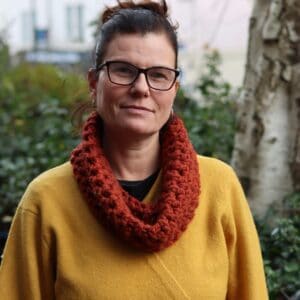 Jill: My role is Engagement Support Worker when I’m at Lifeline (crisis support), Monday, Wednesday and Friday. On a Tuesday and Thursday, I’m a Life Skills Facilitator, working with guests through our Life Course.
As an Engagement Support Worker, I deliver support in a recovery-focused and person-centred way, which builds confidence and helps people to move forward. Manage referrals, book appointments and make follow up calls after crisis session. Make onward referrals and signpost where necessary. I provide support to individuals who are experiencing crisis and acute distress, including one to one support, support planning and liaison with local services.
We act as advocates for our clients and liaise with a range of external agencies like health care providers, probation services, local authorities, education and employment services. We signpost people internally to our other projects like The Life Course which provides a holistic support package for our clients. Because I facilitate the Life Course, when people come from Lifeline, they already know me so that works nicely.
If clients are new to Bath and they’re homeless, we have strong relationships with the outreach team (Julian House’ rough sleeper support) who would come in to us on a Lifeline day. New clients can chat to them.
The framework we use within Genesis Life Projects uses Psychologically Informed Environments [PIE] and trauma informed approaches, so that people feel safe and secure when they come to us.
Can you tell me a little bit more about what that looks like? What is a trauma informed approach?
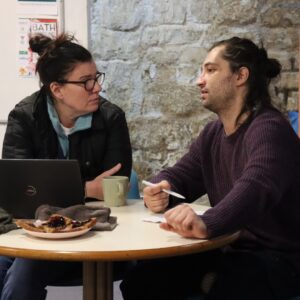 Using trauma-informed and person-centred approaches helps us to be understanding and compassionate. It’s crucial for building rapport and trust. Things like having good listening skills, the ability to listen, understand when someone’s having a difficult day is important.
The PIE framework informs how our centre is set up too with things like soft furnishings, people can help themselves to tea and coffee, and sit with other clients. We find that clients feel comfortable and safe in our environment, so they’re bringing other people into us.
That’s what happened with Dean, who is featured in our Christmas Appeal?
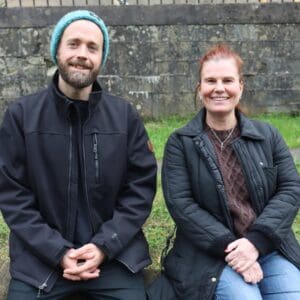 Yes, Dean came in to us via another client who had journeyed with Genesis and who occasionally still comes in for support. He also did the Life Course, so he’d experienced that holistic journey within Genesis Life Projects.
So can you tell me a little bit about what you did before you came to Genesis? You’ve been working in Bath quite a long time, I believe.
I have. Before Genesis I had a variety of roles. I worked at an infant school supporting children with special educational needs as a specialist teaching assistant. The job I had prior to Genesis was with supported living services providing support for adults with learning difficulties and mental health challenges. I helped individuals live more independently by assisting with daily living tasks, developing life skills, promoting social inclusion, or provided practical support activities like cooking or budgeting. I also encouraged clients to build relationships and partnerships within their community.
How do you think that work has helped you in your role with clients at Genesis Life Projects?
I think having a good knowledge of the area and knowing the barriers that people face to accessing support. Working with people that had different communication styles has definitely helped working here. Also because I was in the community for quite a long time in Bath, I knew a lot of our clients prior to working here.
I already had working relationships with local agencies. So often I’ll phone people up and I’ll say, ‘oh, hi, do you know I used to work with you when I worked for so-and-so’.
If someone comes in to us in crisis and they haven’t been able to access support, what might be a reason why they haven’t been able to do that themselves without us?
So as an example, if we’re supporting somebody that’s needing medication, but can’t access their GP because of a mental health crisis. They may well be topping up with other substances, which doesn’t help. We can help them collect their medication or get it reinstated. We can help them with another pharmacy if that’s the issue. It comes back to that advocacy again. For many of our clients they don’t have the support networks we have around us. Genesis can become that support network and signpost people to other agencies that can provide the right support.
What would you say stands out in the support given by Genesis Life Projects?
The compassion. Listening. People often comment on how safe they feel when they come here. I think the fact that we’re a Christian charity, that we are guided by Jesus’ ask to help others. As a staff team, we pray in the morning and that’s where we’re starting from.
Our Christmas Appeal is focusing on the housing crisis in Bath and how it’s affecting the most vulnerable people in our community. How has Genesis seen this?
 In the past, a large proportion of people at risk of homelessness would have had their housing needs met by councils or housing associations. Today, many single homeless people have no choice but to rent from a private landlord, particularly in England. We can see this with Dean’s story. He managed to get a bridging loan to help with a deposit, but some landlords won’t accept that. Landlords don’t have to be vetted, so people like Dean are experiencing safety concerns, which leaves people quite vulnerable. We know most people are only one pay-check away from homelessness.
So Genesis Life Projects is sort of replacing that safety net that other people would have through family or community connections?
Absolutely. Some of our clients often refer to us as their Genesis family. Because we build that close relationship with them. And so they looked at us to provide those essential needs.
Looking at like Maslow’s hierarchy of needs, we make sure that those basic needs are met so that people can then hopefully get on to the next stage and then we build up from that. That’s something we explore within Life Course as well.
How can supporters help homeless and vulnerable people they might see or know?
So many, but not all, rough sleepers have addiction issues and obviously giving them money will feed their addiction. So donating to charities like ours is the most effective way to assist. Signposting people you meet to the professional services and knowing what or where the charities are is quite useful too. Most charities, including us, have leaflets and cards that you can hand out. Offering a warm drink or food is good. I’d say that’s a better way to support people in the community.
One of the things that’s generally banded about is, ‘oh, I need money for the night shelter’, but they don’t charge people to stay. So I think being informed and knowing your community is helpful. If you are concerned about somebody, you can email us or call us and we can assist. Support from the community is vital for our work with vulnerable people. O thank you to everyone who supports us.
Please support our Christmas Appeal this year so we can continue to support people like Dean who find themselves with a safe place to call home.
Thank you for your support.
Related Posts